Now, more and more companies have realized that the intelligent era is coming, and they must embrace AI, introduce agents, and allow large models to enter their business systems.
But how to implement it to generate the greatest value?? Whether to use AI to replace manual coding, consult knowledge bases, generate reports, or use Skills to automate workflows?
These are certainly valuable.
However, if the company only stays at this level, the problems will be obvious:
1. The use of simple tools only improves local work efficiency; 2. If the business process only runs faster, but does not make the product stronger, does not deepen the scenario, and does not allow customers to gain new value, it will be difficult for the enterprise to form real differentiation.
The result may be: fewer and fewer people within the enterprise, because a few people plus agents can complete the original work. However, as models and tool capabilities become more popular, most companies will gradually gain similar efficiency-improving capabilities. Eventually, the efficiency advantages will soon be wiped out, and the company's revenue, product value, and competitive barriers may not really improve.
Therefore, when enterprises embrace the intelligent era, they cannot just ask:
How many people can AI save me?
You should ask more:
What new value can AI enable me to create for my customers? Can AI make my product smarter? Can AI allow me to make a scene deeper? Can AI help me move from “selling tools” to “delivering results”? Can AI allow me to move from “recording data” to “using data to participate in judgment and action”?
This is what intelligent era companies really need to think about.
Below we analyze from the shallower to the deeper how companies should correctly embrace the intelligent era.
The first stage: using AI to improve efficiency is necessary, but not the end point
When enterprises embrace AI, they usually start by improving efficiency.
This is the most natural and easiest step to take. Because there are a lot of repetitive, procedural, and documentation tasks within the enterprise, such as:
- Write weekly reports, daily reports, and meeting minutes;
- Organize customer information;
- Generate sales emails;
- Summarize contract terms;
- Query the enterprise knowledge base;
- Handle standard customer service issues;
- code development;
- Automatically generate a first draft of business analysis.
These tasks used to take people a lot of time to complete, but now large models and skills can be used to improve efficiency.
The so-called Skill can essentially be understood as:
Encapsulate a certain type of repeatable work capabilities so that AI can be stably called, executed and reused.
For example, "Generate sales follow-up emails" is a Skill, "Extract payment terms from contracts" is a Skill, "Generate customer service responses based on customer questions" is a Skill, and "Deploy code in the warehouse" is also a Skill.
This type of capability can greatly improve the internal efficiency of an enterprise. It is suitable as a starting point for AI implementation.
But companies need to be clear:Improving efficiency is only the first step, not the end of the strategy.
Because performance-enhancing AI is easy to copy. As long as large model capabilities continue to improve, office software, enterprise software, and platform manufacturers will have built-in similar capabilities. Today you use AI to write reports, and tomorrow your competitors can use it too. Today you use AI to do customer service summaries, and tomorrow every company in the industry will do it.
If AI only helps companies "do the same thing with fewer people," then it will bring more cost optimization than strategic growth.
The second stage: Intelligentize traditional software and make use of sleeping data
Over the past two decades, companies have built a large number of information systems.
CRM records customers, ERP records orders and inventory, OA records approvals, the HR system records employees, the financial system records revenue and expenditure, the customer service system records work orders, and MES, WMS, and TMS record production, warehousing, and transportation.
These systems accumulate large amounts of data.
But the reality is that a lot of data is not really used.
They are mainly used for:
Records, queries, statistics, and reports.
In other words, the information system in the past was more of a "recording system" than a "judgment system."
Enterprises know that they have a lot of data, and they also know that this data may be valuable, but it used to be very costly to actually turn the data into predictions, recommendations, optimization and actions.
Because in the past, this required the cooperation of business experts, product managers, data engineers, algorithm engineers, software engineers, and implementation consultants. Enterprises must not only understand the business problem, but also clean data, define indicators, select algorithms, develop models, embed systems, design interfaces, and train employees. This link is long and expensive, so many companies’ data ends up just sitting in the system.
Large models change this.
The key value of large models is to allow data originally sleeping in the system to enter business judgment and action links. Large models can serve as the connection layer between business, data, and algorithms, helping companies transform data into business problems, risk signals, prediction results, action recommendations, and process triggering conditions.
For example: 1) Customer communication records, transaction history, contract amounts and service orders stored in the CRM used to be just data used by sales to check customer information; with the help of large models and algorithms, they can be turned into customer stratification, churn warnings, transaction probability predictions and next follow-up suggestions. 2) The order, inventory, procurement, and delivery data in ERP used to be just a ledger for operations personnel to query; now they can be turned into shortage predictions, backlog warnings, replenishment suggestions, and supply risk reminders. 3) The work orders, conversations, satisfaction and processing time in the customer service system used to be just service records; now they can be turned into product problem discovery, customer emotion recognition, SLA risk warning and service strategy optimization.
In other words, large models advance enterprise data from "queryable" to "understandable, judgeable, recommendable, and actionable." Data is no longer just a historical record in a report, but begins to participate in prediction, warning, recommendation, optimization and execution.
This is not simply adding a chat window to traditional software, but upgrading the software from "recording what happened" to "judging what should be done next."
This is a very important type of opportunity in the intelligent era:
Activate the data in traditional software and let the data participate in business judgment.
This type of opportunity is easier to implement than the complete intelligent closed loop discussed later, because companies do not need to reconstruct the entire process from the beginning, nor do they need to take responsibility for the complete results immediately. As long as it can provide better predictions, warnings, explanations, recommendations and analysis on existing systems, value can be generated.
What this stage solves is "how companies can use existing data." Its focus is to transform data from a recording asset into a judgment asset. But if these capabilities only serve internal operations, the main value it brings is still efficiency and management improvements. Only when these intelligent capabilities are embedded in the products and services themselves and become capabilities that customers can directly use and pay for, is the third stage.
The third stage: Use AI to reconstruct product value, rather than just doing internal intelligence
The main change in the first two stages is the internal cost structure of the enterprise. The more strategic questions are:
Can my customers get an experience they didn’t have in the past because of AI? Can my product solve problems that could not be solved in the past because of AI? Can my services change from standardized delivery to personalized delivery because of AI? Can my business model change from selling functions to selling results and sustainable value because of AI?
This is the key to AI moving towards “product capabilities”.
For example, an education company used to sell courses, question banks and live classes. With the addition of AI, the product is not just a question-and-answer assistant, but can become a personalized learning system: it continuously understands each student's weak points, dynamically adjusts the learning path, generates personalized exercises, explains the reasons for errors, and provides continuous companionship and feedback during the learning process.
An insurance company used to sell insurance policies and claims services. After AI is added, the product will not only improve the efficiency of claims review, but can also become a risk management service: identify customer risks in advance, remind customers to prevent losses, automatically organize claim materials, track claims progress, and extend insurance from "post-event compensation" to "pre-event prevention and ongoing management."
An industrial equipment company used to sell equipment. After AI is added, the product is not just a question and answer about equipment manuals, but can become an intelligent service for equipment operation: continuously monitoring equipment status, predicting failure risks, recommending maintenance plans, reducing downtime losses, and allowing enterprises to move from "selling equipment" to "selling equipment availability."
A financial and tax services company used to sell accounting and tax preparation. After AI is added, the product not only automatically generates vouchers, but can also become an operation companion system: it continuously analyzes cash flow, expense structure, tax risks and operating abnormalities, and provides understandable and executable business suggestions to small business owners.
The focus of these changes is not how much work AI has done within the enterprise, but:
AI gives the product itself new capabilities, Allowing customers to obtain a depth of service that was not available in the past, This gives companies the opportunity to move from selling tools and functions to selling results and sustainable value.
Therefore, when enterprises embrace the intelligent era, they cannot just stop at “making internal processes faster.” What’s more important is to think about:
Can AI turn my product into a system that understands customers better, is better able to judge, is better able to act, and is more capable of continuous evolution?
When AI becomes part of product capabilities, it is possible for companies to move from "internal efficiency improvement" to "customer value addition."
The fourth stage: Deepen the scene to form a truly intelligent closed loop
The most valuable company in the intelligent era does not simply say "I have AI capabilities" in general, but can create a closed loop of data, rules, processes, permissions, execution, feedback and results in a specific scenario.
Enterprises cannot just be a general AI assistant, nor can they just be a universal Q&A portal. For most enterprise-level AI applications, truly sustainable business value often comes from deep scenarios.
What is a deep scene?
It’s not industry labels like “Financial AI”, “Educational AI”, “Manufacturing AI” or “Medical AI”, but specific to a type of work or decision-making:
- Enterprise qualification declaration;
- Customer service refund and reissue processing;
- Supplier admission review;
- Preliminary review and filing of contracts;
- Financial monthly statements and reconciliation;
- Inventory replenishment optimization;
- production schedule;
- Customer service scheduling;
- Logistics scheduling;
- Advertising budget allocation;
- Optimize risk control strategies.
These scenarios have clear inputs, rules, procedures, exceptions, results, and feedback.
To develop deep scenarios, companies need to answer a series of questions:
How on earth is this done? What data is needed? What data is trustworthy? What rules must be followed? What actions can be automated? Which nodes must be manually confirmed? What is right? What is failure? How to remedy an error? How are the results fed back to the system?
If these questions are not thought through clearly, AI can only be a tool that looks smart.
Only when enterprises think through these issues clearly and allow AI to continuously judge, execute, verify and iterate in real business processes can AI truly become part of the business system.
The core of intelligent era is not to "add an AI button to all processes", but to:
Deepen a high-value scene to form a smart closed loop of sustainable optimization.
Forming two types of intelligent closed loops in deep scenes
From a strategic perspective, companies embracing the intelligent era will eventually move towards two important closed loops.
Category 1: AI service closed loop, get the work done
The core of this type of closed loop is:
Not just giving customers a tool, but directly completing a type of verifiable business work for customers.
For example, traditional software only helps customers fill out forms, while AI service closed-loop can help customers complete the entire application process: judging materials, extracting data, filling in reports, verifying, submitting, tracking, processing rejections, supplements, filing, and feeding back success and failure experiences to the system.
The value of this type of closed loop is that it goes into not just the software budget, but the service budget and the human budget.
What customers buy is not a feature, but a result.
Scenarios suitable for this type of closed loop usually have several characteristics:
- High frequency repetition;
- The rules are relatively clear;
- Data is available;
- The results can be verified;
- Mistakes can be remedied;
- Labor costs are higher;
- The customer is already paying for this.
The essence of this type of model is:
From selling tools to selling jobs; From software assisting people, to AI and software working together to complete work.
Category 2: Intelligent decision-making closed loop to make optimal decisions
Another type of closed loop is not to complete a specific job for customers, but to help companies make better business decisions under complex constraints.
Its process is usually:
Data collection → Prediction → Optimization → Decision → Execution → Feedback → Parameter update → Re-optimization
For example, in inventory replenishment, production scheduling, logistics scheduling, customer service scheduling, advertising, dynamic pricing, risk control strategies, and supply chain planning, the core issue is not "can AI chat like a human?" but:
Can companies make better decisions under limited resources and complex constraints?
In this type of scenario, the large model is not necessarily the core solver. The real core may be predictive models, optimization algorithms, rule engines, simulation systems and business execution systems.
The value of large models lies in helping enterprises reduce modeling costs, interaction costs, and interpretation costs. It can help business personnel define goals, express constraints, understand algorithm results, diagnose anomalies, and adjust strategies.
The essence of this type of closed loop is:
From empirical decision-making to continuous optimization driven by data and algorithms.
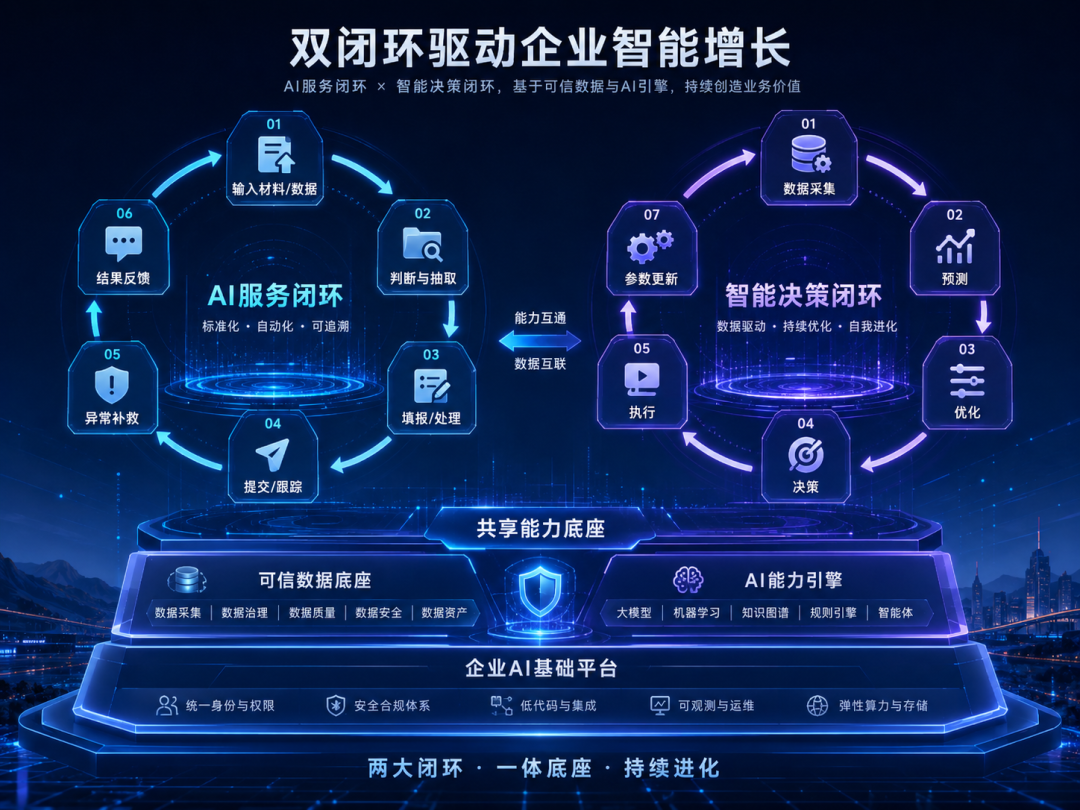
Earlier we talked about the four stages of enterprises embracing the intelligent era: the first stage is to make people more efficient; the second stage is to make data more useful; the third stage is to make products more valuable; and the fourth stage is to make scenarios form a closed loop.
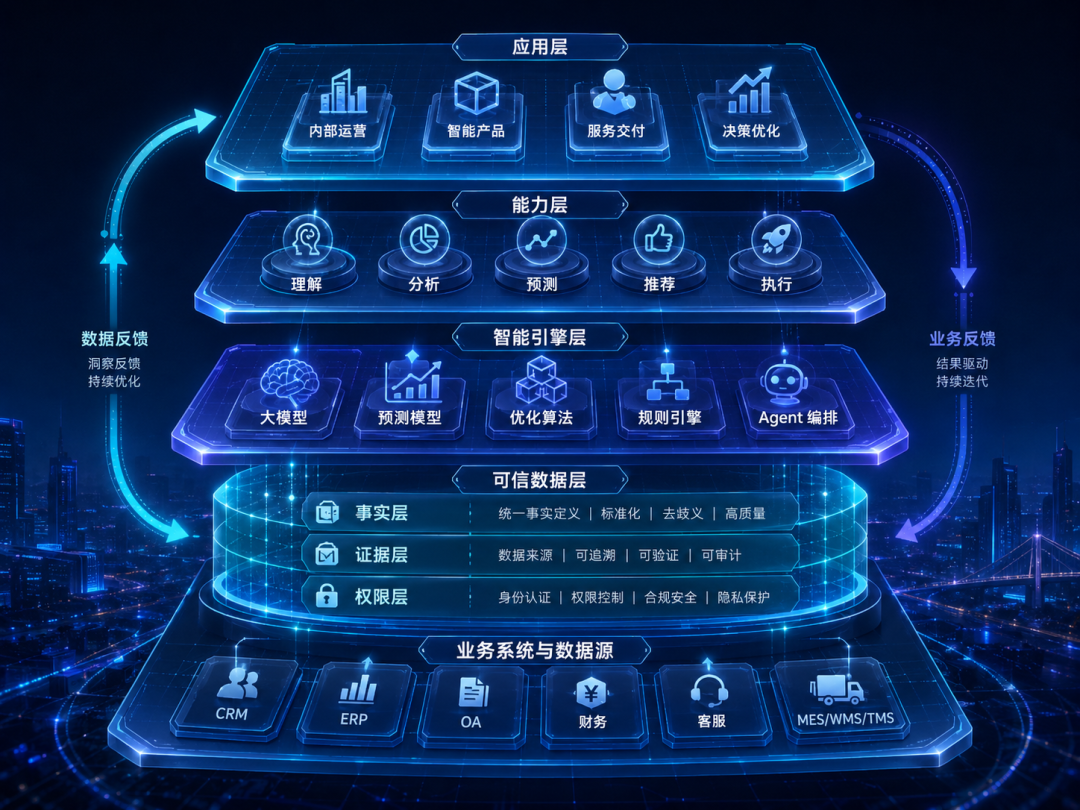
But when it comes to implementation, the closed loop will not be automatically established just because of AI. For AI to enter real business systems, it must also solve a more basic question: What facts does it base its judgment on? What data does it call? What can it access, modify, and execute? Is there evidence for its judgment, is the process traceable, and are the results auditable?
These questions collectively point to a foundation: the trusted data layer.
5. Trusted data layer: the foundation of enterprise AI from “able to demonstrate” to “dare to use”
Whether it is an AI service closed loop or an intelligent decision-making closed loop, you cannot rely on models to "guess".
For enterprises to truly integrate AI into their business systems, they must first solve several problems:
Which data source is authoritative? Which field comes from where? Which document is the latest? What data is conflicting? What content can be used automatically? What content must be manually confirmed? Which Agent has access to which systems? What actions can be automated? Which operations must leave audit records?
Therefore, when enterprises embrace the intelligent era, they must not only buy models, agents, and tools, but also build a trusted data layer.
The trusted data layer consists of at least three parts:
First, the factual layer. Tell the AI what is true. For example, customer information is based on CRM, contract status is based on contract system, inventory quantity is based on WMS, and financial data is based on financial system.
Second, the evidence layer. Tell humans why the AI makes the judgment it does. For example, which document, which field, which system, which point in time does a certain conclusion come from, whether it has been manually confirmed, and whether it conflicts with other data.
Third, the permission layer. Tell AI what can be seen, what can be modified, and what can be submitted. The more capable the AI is, the more important permissions become. There are no authority boundaries. The stronger the AI, the greater the risk.
The trusted data layer determines whether enterprise AI "looks smart" or "business really dares to use it."
6. The right path for enterprises to embrace the intelligent era
Companies should not ask immediately:
Do we want to be Agent?
Instead, four questions should be asked in order.
First, which businesses deserve intelligence?
Not all processes are worthy of AI. Enterprises should give priority to:
- Occurs frequently;
- High labor costs;
- Good data foundation;
- Rules can be described;
- Results can be measured;
- Scenarios that have a direct impact on customer value or revenue growth.
In particular, avoid selecting only internal low-value processes. Those processes, while easily automated, have limited strategic value.
What truly deserves priority are scenarios that can improve product functionality, customer experience, business revenue, and scenario depth.
Second, what role does AI play in this scenario?
AI may have four roles:
Assistant: Help people complete their work faster.
Analyst: Makes judgments and recommendations based on data.
Executor: Calls tools and advances processes within the scope of authorization.
Service Deliverer: Works with human experts and software systems to deliver the final result.
Different roles correspond to different risks, different costs, and different technical architectures.
Enterprises cannot hand over all tasks to Agents from the beginning. The correct approach is to start with low-risk, high-frequency, and verifiable links and gradually expand the boundaries of AI's responsibilities.
Third, how to let AI enter the product instead of staying as an internal tool?
This is the most critical step.
Companies should think about:
- Can my product change from a "function menu" to a "smart assistant"?
- Can my product proactively detect problems instead of waiting for users to inquire?
- Can my product suggest next steps instead of just showing data?
- Can my product explain the cause instead of just outputting the result?
- Can my product do part of the task rather than just letting the user do it?
- Can my product generate feedback to make the service better next time?
If AI were merely an internal efficiency tool, the benefits it would bring could easily be matched.
If AI becomes part of product capabilities, it has the potential to transform customer experiences, business models, and competitive barriers.
Fourth, how to form a closed loop instead of doing one-time functions?
Many AI features are impressive when first launched, but have insufficient long-term value. The reason is that they don't have closed loops.
for example:
- The AI generates a report, but no one knows if the report is useful;
- AI recommended a customer, but no one tracked whether the transaction was completed;
- AI judged a risk, but no one gave feedback whether the judgment was correct;
- AI automatically handles a ticket, but no one records whether the customer is satisfied or not;
- AI gives replenishment suggestions, but no one has verified whether it actually reduces out-of-stocks.
Without feedback, AI cannot continue to get better.
Therefore, when companies develop AI, they must design a feedback mechanism from the beginning:
What did the AI do? What did the person modify? Was the result successful? What went wrong? Why did it go wrong? How to improve next time?
Intelligent systems are not developed once and for all, but continue to evolve in real business.
Conclusion: In the intelligent era, what companies really need to do is to redefine value.
The capabilities of the large model are getting stronger and stronger, and the Agent will become more and more mature. In the future, almost all businesses will use AI to improve efficiency. Writing code, checking information, doing customer service, generating reports, and processing processes will all become standard.
But standard equipment will not create a long-term advantage.
When enterprises embrace the intelligent era, they cannot just stop at “using AI to do things faster.”
What's more:
Use AI to do things that couldn’t be done in the past, Use AI to give products new capabilities, Use AI to deepen the scene, Use AI to build a truly sustainable business closed loop.