In the previous articles, we analyzed how enterprises should build intelligent agents from the perspectives of enterprise trusted data layer, Ask-Data, scenario-level closed-loop intelligence, and enterprise agent architecture. In "Looking at the Universal Enterprise Agent Architecture from Anthropic Financial-Services", we mentioned that the core of the universal enterprise agent architecture is Skill and unified semantic model. Now many people have realized the importance of Skill, but have relatively ignored the unified semantic model.
In today's article, we string together the previous articles and give an implementation plan for unified semantic model.
Let’s briefly review the relationship between the previous articles:
- In "Enterprise Agent's Trusted Query Issues", we discussed why enterprise agents need trusted query; in "Enterprise Trusted Data Foundation Architecture and Manufacturer Review", we further sorted out the architecture and construction path of the trusted data foundation;
- In "Ask-Data Technology Route and Selection", we analyzed the mainstream technology route of Ask-Data, a typical enterprise agent scenario, and pointed out that: the semantic layer is the core infrastructure of enterprise-level Ask-Data;
- In "Ask-Data semantic Layer Framework: Introduction to Cube Core", we introduced Cube, an open source semantic layer for BI, embedded analysis and AI Agent, and analyzed why it is suitable for semantic layer and Ask-Data scenarios;
- In "How Enterprises Should Embrace the Intelligent Era: From AI Efficiency Improvement to Product Reconstruction and Closed-loop Execution", we proposed that when enterprises embrace the intelligent era, they cannot stop at "doing things faster with AI", but should focus on product innovation, scenario development, and sustainable business closed loops;
- In "Looking at the Universal Enterprise Agent Architecture from Anthropic Financial-Services", we refer to Anthropic's solution and abstract a set of enterprise-level Agent architecture that can be migrated to various industries.
These articles are not isolated.
"Trusted Query" answers: Why enterprise-level Agents cannot just rely on memory or context, but must access enterprise data through trusted query.
"Ask-Data" takes a specific and classic enterprise agent scenario as an example to further explain why Ask-Data requires a trusted query and how to design a trusted query. The significance of Ask-Data is not only to make data access more convenient for business personnel, but also to enable Agents to have trusted data access in the intelligent era through this architecture and further support the business closed loop.
When it comes to the article "general enterprise agent architecture", we refer to the Anthropic financial-services solution and give the general enterprise agent architecture. One of the cores of this architecture is the unified semantic model. The problems that the unified semantic model needs to solve are highly consistent with the semantic layer in Ask-Data: they both abstract the underlying complex data tables, fields, indicators, permissions, and relationships into stable and manageable business semantics.
Therefore, Ask-Data is not an isolated scenario, but a typical aspect in the enterprise agent architecture. It allows us to see the importance of the unified semantic model in advance: only by unifying data, indicators, permissions and relationships can the Agent access, analyze and execute data reliably.
"How Enterprises Should Embrace the Intelligent Era: From AI Efficiency Improvement to Product Reconstruction and Closed-Loop Execution" further explains that the goal of enterprises as agents cannot stop at "making internal work more efficient." The truly valuable direction is to move data from "queryable" to "understandable, judgeable, recommendable, and actionable", allowing AI to enter product capabilities and real business scenarios, helping companies deepen a high-value scenario, and ultimately forming an AI service closed loop or intelligent decision-making closed loop. In other words, the ultimate value of an enterprise agent is not just to complete tasks for people, but to reconstruct product value, deepen scenarios, and continuously optimize the business.
But to do this, the Agent must have a trusted data foundation. It needs to know what facts to base its judgment on, what data to call, what to access, what to modify, what to execute, whether there is evidence for judgment, whether the process is traceable, and whether the results are auditable. These problems ultimately come back to an infrastructure: the trusted data layer, and the unified semantic model on top of it.
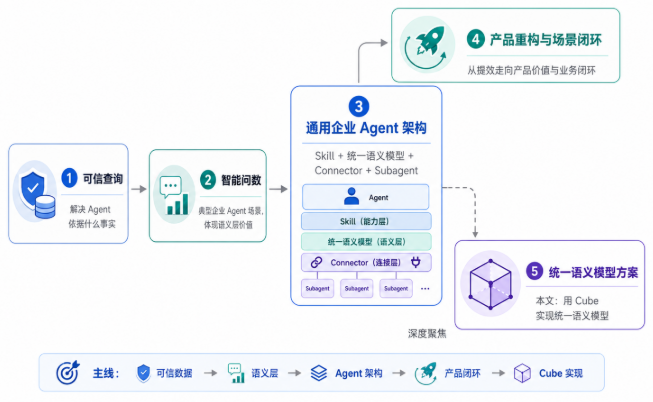
Among these articles, "General Enterprise Agent Architecture" is the core article for the implementation of enterprise agent. The article mentioned the unified semantic model, but did not elaborate on how it should be implemented. What this article wants to make up for is exactly this link: we provide a practical implementation solution, which is Cube.
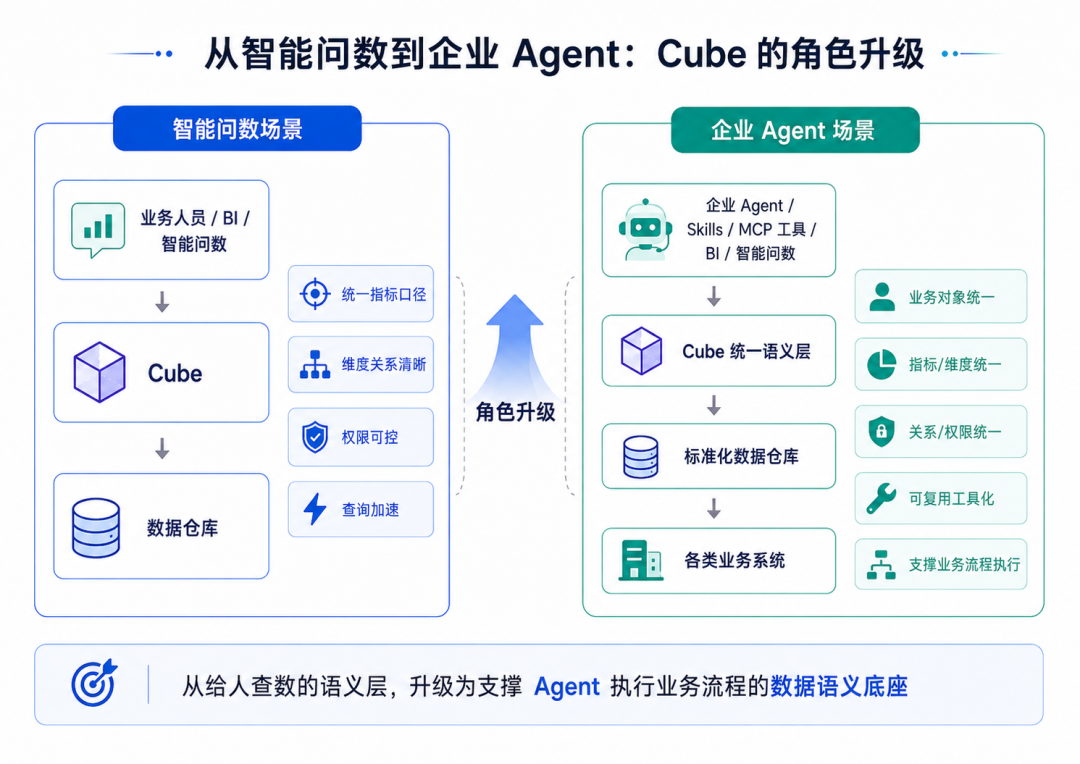
Cube can not only be used in BI, reporting, and Ask-Data scenarios; it can also be used in enterprise agent architecture, and its role will increase significantly: from "a semantic layer for people to check numbers" to "a data semantic base that supports Agents in executing business processes."
It can be understood like this:
Ask-Data scenario
Business People/BI/Ask-Data
        ↓
       Cube
        ↓
      data warehouse
intelligent era
enterprise agent / Skills / MCP tools / BI / Ask-Data
                    ↓
             Cube unifies semantic layer
                    ↓
              Standardized data warehouse
                    ↓
               Various business systems
Why Cube can be used in general Agent architecture
In the Ask-Data scenario, the core difficulty of enterprise-level data querying is not whether the LLM can write SQL, but whether the indicator caliber, dimension relationship, permission boundary and query path are unified. For example: how to calculate GMV, how to define new customers, whether revenue includes refunds, whether this month is a natural month or a financial month, whether users can view data of a certain department, which join path should be taken between multiple tables, whether the results are traceable, and whether the cache is hit. Cube's positioning is to forward these indicators, dimensions, relationships, permissions and query acceleration capabilities into the semantic layer, allowing BI, applications and AI agents to face stable and manageable business semantics objects instead of directly facing the underlying data sources.
In the general enterprise agent architecture, the Agent should not directly face the underlying tables and fields in ERP, CRM, MES, QMS, CLM or data warehouse. Because the field naming, indicator caliber, association relationships and permission rules of different systems are often inconsistent. If the Agent is allowed to directly query these underlying data, each Agent, each Skill, and each MCP Tool will have to re-understand the enterprise data, and a large amount of custom logic that cannot be reused and cannot be managed will be formed in the long run.
A more reasonable way is to let the Agent face unified business objects.
For example, in a financial scenario, the Agent should face:
TrialBalance JournalLine SubledgerItem Invoice Payment AccountMapping
In a manufacturing scenario, the Agent should face:
ProductionBatch InspectionResult MaterialLot MachineEvent CAPA
These business objects are the core components of the unified semantic model.
It can be seen that a large part of the core capabilities required by Agent's unified semantic model are exactly what Cube is good at providing: unifying the underlying complex data tables, fields, Join relationships and indicator calculations into business objects, indicators, dimensions, relationships and permission boundaries.
How Cube is used in the general Agent architecture
After using Cube, Agent calls business semantics tools encapsulated based on Cube through MCP Server, for example:
get_trial_balance(entity, period) get_ar_open_items(entity, as_of_date) get_batch_history(batch_id) get_inspection_results(batch_id) get_contract_risk_metrics(contract_id)
In this structure, the relationship between Cube, MCP Server, Skills and Agent can be understood as follows:
Cube: Defines unified business semantics for enterprise structured data MCP Server: Packages these semantic capabilities into business tools that can be called by Agent Skills: Solidifies expert SOP, inspection rules, calculation methods and output templates Agent: Arranges Skills and Tools to complete end-to-end business processes
Therefore, the value of Cube is not just to "make it easier for Agents to check numbers", but to enable Agents to work based on unified, stable, and manageable business semantics when executing complex business processes such as reconciliation, root-cause analysis, review, and report generation.
It should be noted that Cube is mainly responsible for the Agent's read path and analysis path, such as query, aggregation, indicator calculation, dimension filtering, object association, permission control and cache acceleration.
Actions such as write operations, approval flow, posting, sending letters, closing work orders, and updating CRM should be connected to the business API, approval flow, work order system, or ERP draft area through another set of controlled MCP execution paths.
Agent data access link after using Cube
In the enterprise agent architecture, the more reasonable position of Cube is as follows:
business system
SAP / Oracle / UFIDA / Kingdee / Salesforce / MES / QMS / CLM
        ↓
Data synchronization / ETL / ELT / CDC
        ↓
Standardized data warehouse
Unified fields, master data, historical snapshots, lineage, caliber
        ↓
Cube
Unify business objects, indicators, dimensions, relationships, permissions, cache, and API
        ↓
MCP Server
Packaged into Agent callable business tools
        ↓
Agent
Perform reconciliation, analysis, review, root-cause analysis, and report generation
Note: In an enterprise-level architecture, it is more recommended to connect Cube to a managed standardized data warehouse or lake warehouse, rather than directly connecting to the production business system.
Conclusion
Semantic layers such as Cube can not only serve BI, reports and Ask-Data, solving the problem of "how people query data with a unified caliber"; they can also be used in enterprise agent architectures, and their importance has further increased: it is no longer just a semantic layer for BI, but a unified data semantic base for Agents to execute business processes.
To do reconciliation, review, root-cause analysis, and generate working papers, Agent first needs to have a stable understanding of business objects such as TrialBalance, JournalLine, Invoice, ProductionBatch, and InspectionResult, as well as their corresponding indicators, dimensions, and relationships. Cube can encapsulate these semantics in a unified manner and then expose them through the MCP Server into business tools that can be called by Agents. After the enterprise standardizes data semantics, all Agents can reuse this set of semantic assets, thus turning industry processes into structured workflows that can be automatically executed.